
TWIC is one of those acronyms that shows up on paperwork and disappears again — until something goes wrong. If you move containers through PortMiami, fifteen minutes on TWIC is worth your time.
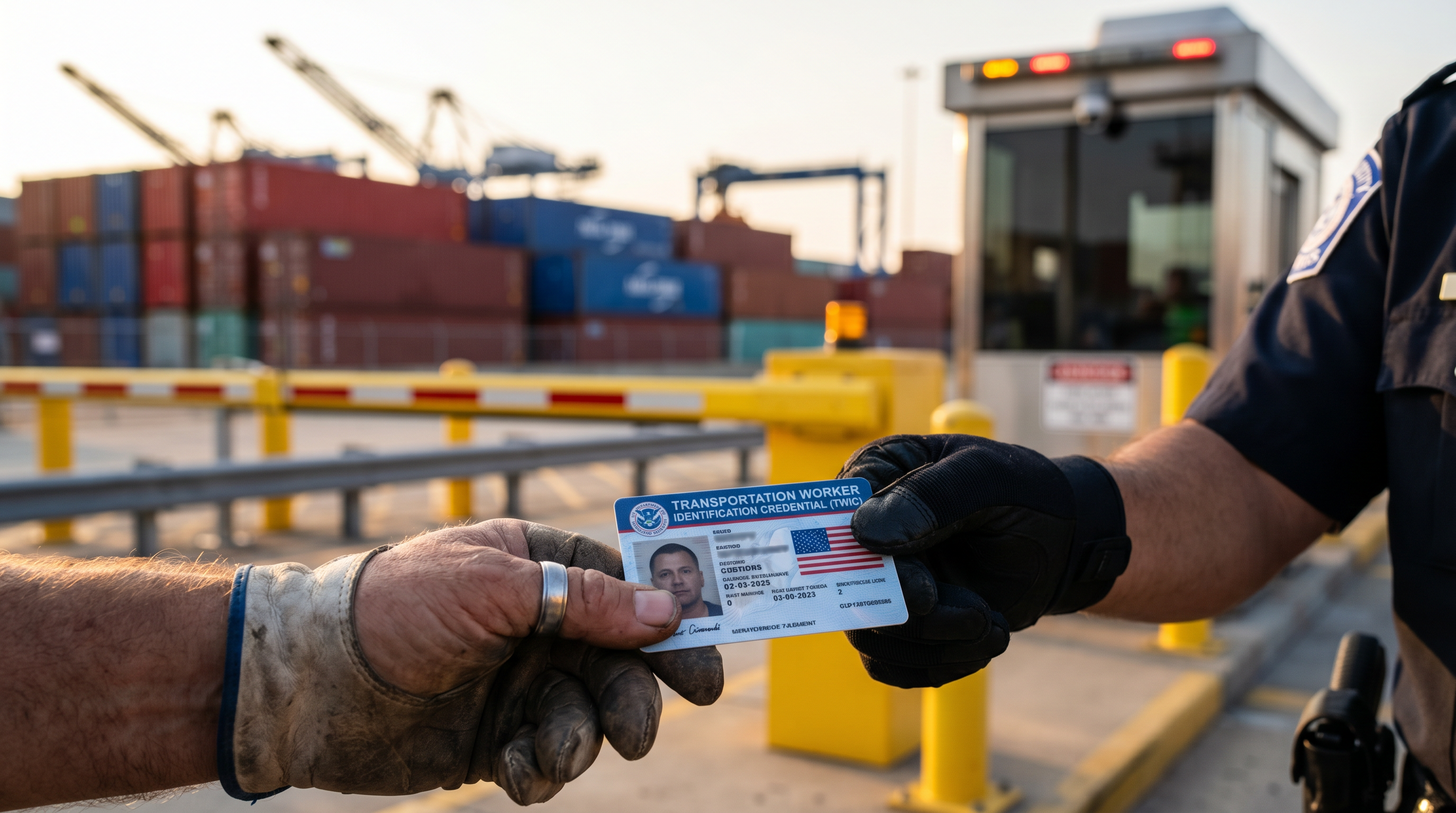
What TWIC Actually Is
TWIC stands for Transportation Worker Identification Credential. It is issued by the Transportation Security Administration (TSA) and required under the Maritime Transportation Security Act for anyone needing unescorted access to secure areas of a U.S. maritime facility.
In practice: every truck driver entering the secure portion of PortMiami, Port Everglades, or any U.S. container terminal must carry a valid TWIC card. No card, no entry.
The basics: issued by TSA, valid for five years, requires a background check and biometric enrollment, costs around $125, and must be physically carried by the driver at the gate. TWIC is the minimum bar for port access — not a substitute for a CDL, hazmat endorsement, or FMCSA authority, which are separate qualifications.
Why TWIC Matters for Your Freight
On paper, TWIC is a driver-level requirement. In practice, it shapes the economics of your drayage lane.
The pool of TWIC-credentialed drivers is smaller than the pool of CDL drivers generally, especially in tight labor markets. Credentialing takes weeks, longer if a background check needs adjudication. Carriers without a dedicated TWIC-credentialed workforce often rely on contractors, and contractor coverage varies day to day. And a missed appointment for a TWIC reason still counts against your free time.
If your drayage carrier has a thin TWIC bench, your moves are exposed to whatever capacity that bench has on any given day. The exposure shows up as schedule slippage long before it shows up as a line item.
What Day-to-Day TWIC Failures Look Like
A normal gate process runs like this: driver arrives with a valid appointment, presents TWIC and license, the system verifies the card is active, driver is cleared in, pickup or delivery proceeds.
Any break in that chain stops the move. Common failure points include expired TWIC (no one caught the renewal), damaged cards (bent or unreadable), revoked or flagged credentials, and wrong-driver assignments where a carrier short on TWIC drivers sends an uncredentialed driver hoping for a workaround that no longer exists.
Each of these is a carrier operations problem. But you pay for it — in demurrage risk, empty-return delays, and missed customer commitments.
Questions to Ask Your Drayage Carrier
Before awarding lane volume, the TWIC questions are straightforward:
- •What percentage of your drivers are TWIC-credentialed?
- •Are your drivers W-2 employees, owner-operators under exclusive contract, or day-to-day contractors?
- •How do you track TWIC expiration across your fleet?
- •What is your backup plan when a TWIC driver is out?
- •How quickly can you credential a new driver if volume spikes?
Questions to Ask Your Drayage Carrier (cont.)
You want specific, numeric answers: "95% of our drivers are TWIC-credentialed. We track expirations six months out. We credential new drivers through the Miami enrollment center." That is an operation. Anything vaguer is an aspiration.
At New Roads Logistics, every driver who touches a PortMiami or Port Everglades move is TWIC-credentialed as a condition of being on the lane. Dispatch tracks credential status alongside HOS and licensing so no driver is ever sent to the port without a valid card.
The Hidden Cost of Borrowed Capacity
When a carrier is short on TWIC drivers and you call with a container that must move today, the pressure to "make it work" is real. Historically, some carriers solved it by chartering a driver from another company, a freelance owner-operator, or a broker-matched truck — and you often had no visibility into who was showing up at the gate.
In 2026, the friction around that kind of borrowed capacity is higher than ever. Terminals are more rigorous about checking TWIC at the gate. Chassis pool access rules slow unfamiliar drivers down. Insurance and UIIA documentation on swapped drivers is sometimes incomplete. This is one of the practical reasons to prefer an asset-based drayage carrier: asset-based carriers credential their drivers because those drivers are their employees.
A Shipper's Quick Checklist
When evaluating carriers for Miami drayage, make TWIC an early filter:
- •Confirm in writing that all port-facing drivers are TWIC-credentialed
- •Ask for the carrier's expiration-tracking process
- •Request the backup plan for driver absences
- •Verify drivers are direct employees or exclusive contractors, not swapped per move
- •Ask how many port appointments they have missed for credentialing reasons in the last twelve months
Credentialing Is an Operational Discipline
The first sign credentialing is not working is an expensive one. Carriers who take TWIC seriously tend to take other disciplines seriously: driver vetting, HOS compliance, cargo handling, insurance. The credential is a reasonable proxy for operational maturity.
New Roads Logistics is an asset-based PortMiami drayage carrier with TWIC-credentialed W-2 drivers, same-day dispatch, and a bilingual team that owns your container from the gate to the door.
**Want to see how credentialing works across our fleet?** Call **(305) 733-1650** or [request a free quote](https://portmiamidrayage.com/contact). We will answer the TWIC questions in detail — on the first call.